To
Kill A Mockingbird
by Harper Lee |
| Reading
and Understanding the Novel
|Unit
Objectives |
|Novel packet |To
Kill a Mockingbird Student Survival Guide| |
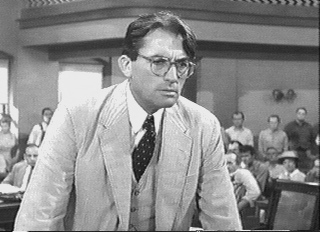
"--there is one
institution that makes a pauper the equal of a Rockefeller, the
stupid man the equal of an Einstein, and the ignorant man the
equal of any college president. That institution, gentlemen, is
a court."
Atticus Finch, Chapter. 20 |
Novel Projects
Option 1:
Multigenre Web Project
Option 2:
Create your own newspaper
|
|

To get back to top |
|
|
|
Most of your reading for this novel
is to be done outside of class, but some reading days are included
in the calendar. Please have your book with you each day. There
will be class time provided for your web page work, but you will
need to work on your web project outside of class also. |
Unit Objectives
- Students will read Harper
Lee's classic novel: To Kill A Mockingbird.
- A novel
packet will help students develop thoughts about characters, keep
the events of the plot straight, and think about ideas in the novel
in preparation for discussion.
- Students will discuss
with peers both online (in Moodle) and face to face in class. See
the unit calendar for discussion days. Students must have their novels
with them on those days.
- Students will show their
understanding of the novel by creating and publishing a novel project.
There are two options in 2008. Both projects are to be created
collaboratively, multigenre in nature, and published online.
Choosing Partners
- No more than three
students per group (no exceptions)
- Choose partners who
share your work ethic
- Choose partners from
your own class period
- Do not leave anyone
partnerless! Look around.
Novel Projects
Option 1:
A multigenre hypertext project
Your multigenre hypertext
project has two main components, but four parts in total:
- one (1) main
essay (literary analysis essay in third person with text
support)
- three (3) connected/related
genre pieces that support, expand, help develop ideas in
main essay
The Main Essay:
This is a collaborative
project, including planning and writing the main essay. As a team, choose
a topic from the following list and work together to plan and write
your essay.
- courage and fear
- some people serve as
moral compasses for the rest of us
- growing up/loss of innocence
- loneliness
- the effects of racial
prejudice on a small community
- the symbolism of the
mockingbird (innocence or goodness senselessly destroyed)
- topic of your own choosing
The essay needs to be organized
logically. You need an introductory paragraph as well as a concluding
paragraph. The body of the essay may be two to four paragraphs, depending
upon how much you have to say.
You are expected to write
- about 350-400 words, minimum; no longer
than 700 words
- a literary analysis: support your
thesis with evidence from the novel (see your Speak
essay for a reminder of what is expected)
- no first or second person
Optional: Go the the graphic
organizers page for tools to use in organizing your ideas.
Making your project a
multigenre hypertext project:
- The main text of your
essay will be supported by three additional pieces
of writing from a variety of genres (you choose). A list follows.
- Each supporting genre
will add to, explain, or support in some other way a significant idea/theme
in your main essay.
- Each support genre piece goes on its
own page (tkam_2, or 3, or 4). Make a link to each page in
the text of the essay.
- For example, say your essay is
about the role of women in the novel. You have written that Scout
is not a typical girl even though her aunt wishes she would be.
You could make "typical girl" into a hyperlink that
goes to a speech from Scout as a grown woman who talks about important
things for women to do. Or it could go to a poem in which she
complains that everyone seems to be trying to make her into something
she's not.
Setting up your website for this
project:
- Choose one person to
store your project. Do not share your network login and password or
web editing password.
- Create a folder for these
pages. Call the folder tkam. In it, put these four pages: main.htm;
tkam_2.htm, tkam_3.htm, and tkam_4.htm.
- Set up the pages for
the project this way. A simple way to
make the pages is to copy the template from the sample page and paste
it on your page. Then make your links live and make other format changes.
- The design must be clear and uncluttered.
Keep good web design principles in mind. Think of readability. No
unrelated graphics. No black or dark backgrounds. No graphic backgrounds
on text pages. Use web safe fonts.
- Each member of your group
should make a link to your main page on his/her webfolio page. Call
it To Kill a Mockingbird project.
- Check the calendar for
the due date.
- A link to the rubric
for this project is at the top of this page.
Option
2: Create and publish a newspaper
- See full
details for this project.
- Your group may need extra
technical support and should plan on staying after school on a Monday
early on in the project to learn more about InDesign or newswriting.
Students choosing this option are expected to do some independent
learning.
- Article planning and writing can occur
without InDesign.
- Write your basic copy (text of articles)
in Word and save.
- Make back up copies of all your work.
- The end result of your project will
be a pdf file that each of you can add to your website. Please see
Ms Hogue for help in making your pdf file and how to publish.
- Each member of your group
should make a link to this file on your webfolio. Call it To Kill
a Mockingbird project.
Choosing
your genres for your multigenre essay
General directions:
- Before choosing a genre, think first
about what your purpose is. What does your group want to say that
you haven't said in your essay? Whose voice is yet unheard? What would
he/she say if he/she could say it? What genre would give that voice
the best chance to make a difference?
- For each genre page, put an appropriate
title or headline at the top of the page. Also, for each of the
three genre pages, you will need a short introductory paragraph that
explains what your reader is seeing.
- Specific help with most genres follows.
Choices:
- A
character study of one of the main
characters.
- A
letter from one character to another.
- A newspaper
article.
- A poem
for two voices using two of the characters in the novel, or one character
and something else. Go to your ThinkBook for a reminder of
how to do this.
- Another
kind of poem.
- An
obituary or a eulogy. Obituaries
in the Sheboygan Press
- A comic
strip (8 panes) that illustrates a major event from the novel.
Use a comic strip from a Sunday newspaper as an example of how to
set up the title, the drawings and the character's voices. You will
need to scan this in. Ask your teacher for a template for the comic
sterip
- A monologue
from one of the main characters that reveals his or her feelings about
an event from the novel.
- A speech.
- A fable
(a short story that teaches a lesson).
- A recipe.
- A fictionalized
journal entry (from the perspective of one of the characters).
- A mandala
(man-dolĺ-uh). This is an activity for those who want a creative
and intellectual challenge. It is a more time-consuming activity.
(If you choose the mandala, you need only one other genre. You must
publish your actual mandala and your questions and answers).
- Something
else? You suggest an idea to your teacher.
Genre
Help
Character
Study
Choose one of the main characters and using words, paint a word portrait
of him or her. Write about any of the following: interests, relationships
with other characters, personality, problems that face him or her, and
or anything else that you think will help your reader understand that
character better. To help you get the information you need, first fill
out a chart like the one that follows. This chart would not be published
on your web page. A character study is written in third person;
you are the author who knows everything about the character. Think about
sentence fluency as you write. Read your character study aloud to make
sure it reads smoothly and that it sounds good.
| What
does this character look like? How old is he/she? What is
his/her name? |
|
| Give
examples of this character's speech/words. |
|
| Give
examples of this character's thoughts. |
|
| Give
examples of this character's actions. |
|
| How
do other characters view this characters? |
|
| What
does this character do for fun or for personal interest? |
|
| What
would this character want if he/she could have anything in
the world? |
|
| What are the relationships
to other characters that this character has? |
|
Letter
Choose one character from column A below and write a letter from him
or her to the character you choose from column B below. The letter should
be written as a personal letter and should include all the important
details you think that person would include in a letter. To help you
decide what to write about, ask yourself what person A has to say and
why. Also, why did you choose person B to get the letter. In other words,
the relationship you create between these two characters will help you
know just what to write in the letter. What does the one have to say
to the other?
| A |
B |
| Scout |
Atticus |
| Jem |
Tom
Robinson |
| Dill |
Mrs.
Dubose |
| Atticus |
Arthur
Radley |
| Arthur
Radley |
Scout |
| Miss
Maudie |
Calpurnia |
| Calpurnia |
Mayella
Ewell |
| Choose
your own pair |
Obituary/Eulogy
An obituary
is a newspaper account of a person's death and life. It generally includes
the main events of his or her life, the person's family, and any special
accomplishments from his or her life. If the person's death was "famous,"
there might be details of the circumstances. The audience for the obituary
is the general public.
Click here for the Sheboygan Press's current obituaries to
use for examples. A
eulogy is similar to an obituary, but it is a speech instead of
an article. A eulogy is given by someone who knew the person well or
by someone in his or her family. The eulogy is generally more personal
and the audience is all the people in attendance at the funeral or memorial
service. In writing either, the main purpose is to honor the life of
someone who has died.
Monologue
A monologue is a part in a play or dramatic narrative where one character
is talking alone. What he or she says represents his inner thoughts
and feelings. He or she may not have an audience other than the reader
or the theatre audience. In other words, the other characters in the
play or narrative do not usually hear the words of the speaker. When
you write this monologue, choice of character is very important. Decide
what he or she is thinking inside. What is he/she feeling? What would
he/she tell the world if it would listen? Also, set the scene. Before
the monologue, in a short paragraph, tell who the speaker is, where
he/she is (set the scene visually), and tell what has happened in the
life of this character so far (very briefly: like "this is after
such and such" or "before the blank happens." This link
to monologue
may help, but if you just write from the character's heart, you will
probably know what you want to say.
News
Article
A good news article answers the basic questions: who, what, when, where,
why and how. It also uses direct quotes from people who were there and
witnessed an event or who know something about the event. A good reporter
will report both or all sides of the story. Use a real news story as
your model for writing this story. Create a headline for the story also. Click
here for an example of a news story. For this
assignment, focus on one event from the novel, such as the trial or
Bob Ewell's harrassment of the children. To get more examples, read
the stories on the front pages of newspapers to get the sound and structure
of a common news story. (News is on the front page. Other types of articles
are found elsewhere in the newspaper).
[Top
of Page] |